How a lot of men think, for women who feel him drifting
He says he’s fine. You know he isn’t.
12 silent signs he’s pulling away, what’s usually going on in his head, and what you can do, even if you’re the only one trying.
Secure checkout · One-time $17 · No subscription
Get the guide — $17Instant PDF download · 30-day refund
Private. We never post, tag, or contact anyone but you.
Sound familiar?
You talk every day. About the dentist, the gutters, who’s doing pickup. Nothing about the two of you.
You ask what’s wrong. “Nothing. I’m fine.”
He comes home and then he’s gone again. The garage, the gym, the phone. “Decompressing” used to take twenty minutes. Now it takes all evening.
You bring something up, calmly, and his face goes flat. “Whatever.” Then he leaves the room.
He doesn’t reach for you the way he used to. And at 2 a.m. the questions start running: Is it me? Is it my body? Is there someone else?
He used to argue with you. Now he says “do whatever you want,” and somehow that feels worse.
If you’re nodding, here’s the first thing to know: you’re not crazy, and you’re not needy. You’re the one who noticed first.
Not another “just talk to him” guide
Most marriage advice starts with “sit down together and share your feelings.”
If he’d sit down, you wouldn’t be here.
This guide comes from the other side of the couch. No jargon, no lectures. It’s how a lot of men actually think, in plain words: the stuff guys say to a buddy, or to nobody, and almost never to their wife. Written with AI tools, from a man’s point of view. More on that in the FAQ.
Here’s where we stand, and not everyone will agree with it: when a man goes quiet, it usually isn’t because he stopped caring. More often he doesn’t have the words. Or he thinks saying it will make it worse. Or “I’m struggling at home” sounds to him like “I’m failing,” and he’ll hide that before he hides almost anything else.
From the outside, quiet looks a lot like not caring. Most of the time, that’s not what it is.
What this guide won’t pretend: it can’t tell you what your husband is thinking. Only he can. What it gives you is a map of the patterns behind the silence, so you’re not guessing alone at 2 a.m., and specific things to try.
What’s inside
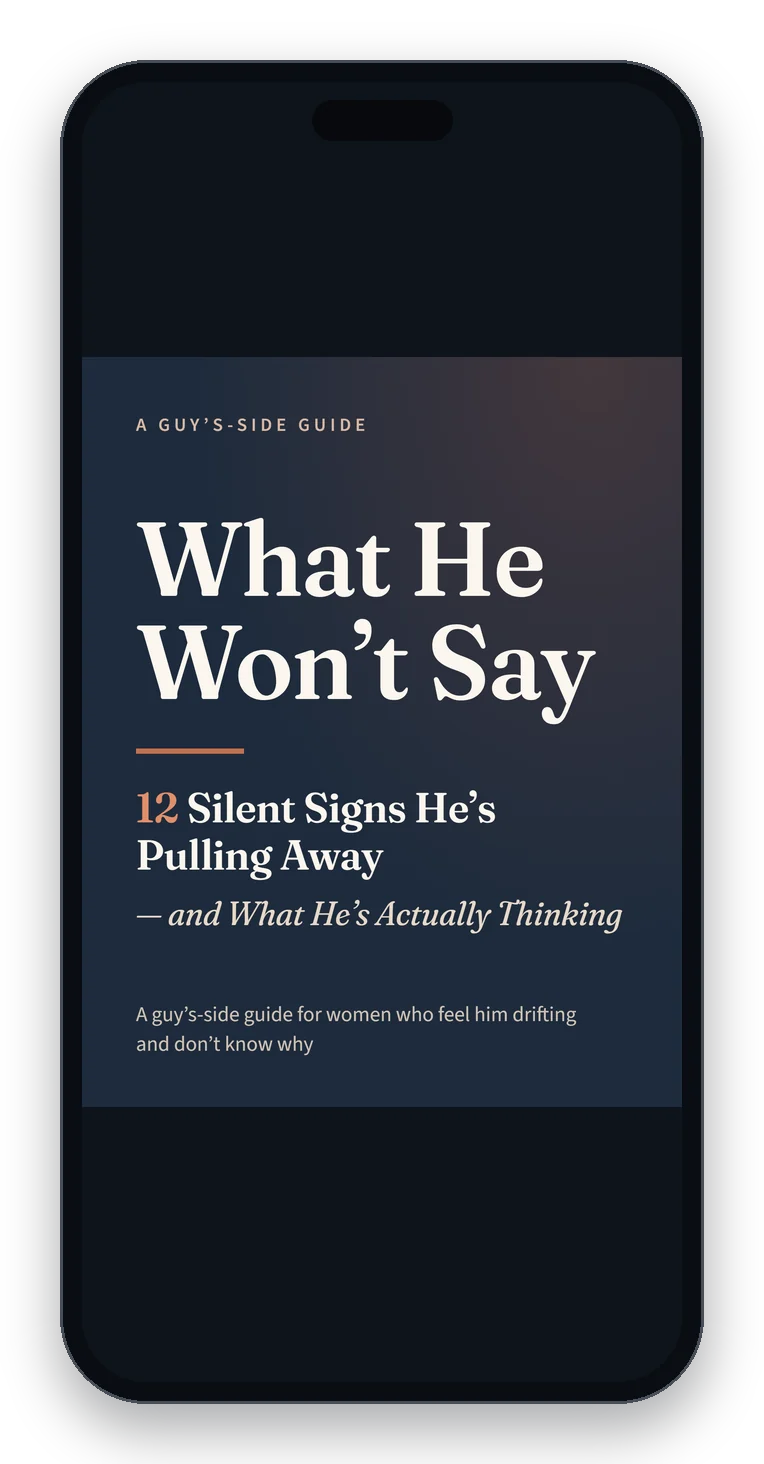
What He Won’t Say: 12 Silent Signs He’s Pulling Away
A PDF guide: 80 phone-friendly pages, about an hour to read.
Each sign follows the same four parts:
- What you see: the thing you’ve already noticed and maybe talked yourself out of
- What’s going on in his head: the part he won’t say
- Why it matters: what happens if nobody touches it
- What to do: specific steps, plus a short line you can actually say
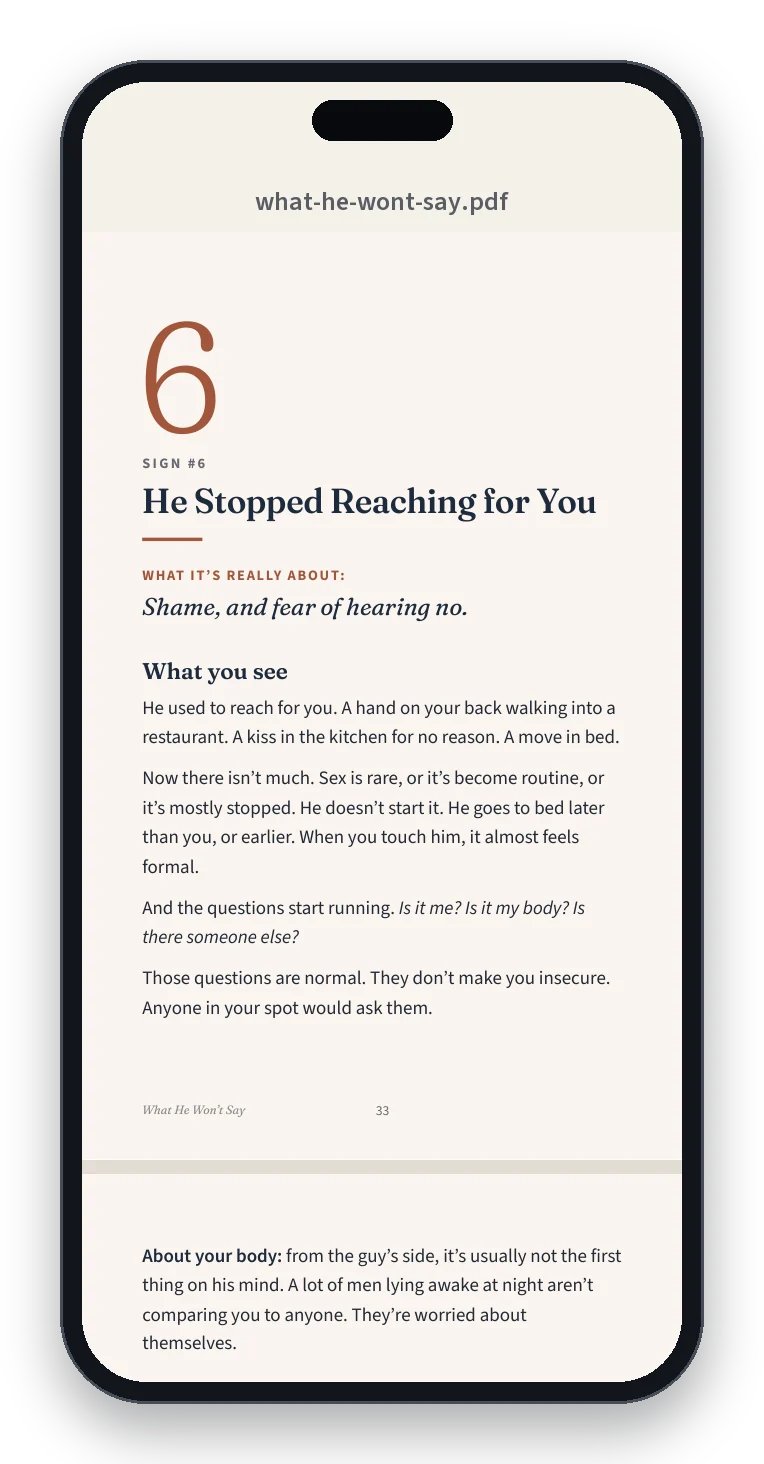
A free taste, from Sign #6
And the questions start running. Is it me? Is it my body? Is there someone else?
Those questions are normal. They don’t make you insecure. Anyone in your spot would ask them.
About your body: from the guy’s side, it’s usually not the first thing on his mind. A lot of men lying awake at night aren’t comparing you to anyone. They’re worried about themselves.
[…]
“I’ve put on weight. I’m tired all the time. I don’t exactly feel like anybody’s idea of sexy.”
[…]
“She reached for me last night and I pretended to be asleep. I don’t even know why. I just couldn’t.”
The lines in italics aren’t quotes from real men. They’re written to show common patterns, so you can recognize them. The full sign also covers the other common reasons, and what to do first.
The 12 signs
- 1You’ve Become RoommatesReally about: a drift nobody named, because nothing broke.
- 2He Disappears Into the GarageReally about: needing one place where he knows what he’s doing.
- 6He Stopped Reaching for YouReally about: shame, and fear of hearing no.
- 8You’re Just Mom and Dad NowReally about: loneliness. Needed, not wanted.
- 12He Stopped Fighting BackReally about: resignation, not peace.
See all 12 signsShow fewer
- 1You’ve Become RoommatesReally about: a drift nobody named, because nothing broke.
- 2He Disappears Into the GarageReally about: needing one place where he knows what he’s doing.
- 3He Shuts Down Mid-FightReally about: overload, not indifference.
- 4Everything Turns Into “Yes, But…”Really about: he hears a judgment of who he is, not a request.
- 5Sarcasm Has Moved InReally about: old hurt that never got said straight.
- 6He Stopped Reaching for YouReally about: shame, and fear of hearing no.
- 7There’s a ScoreboardReally about: invisible work, on both sides.
- 8You’re Just Mom and Dad NowReally about: loneliness. Needed, not wanted.
- 9Money Got QuietReally about: money feels like proof of who he is.
- 10Someone Else Gets His Story FirstReally about: who’s easiest to talk to.
- 11He Stopped Saying “Someday”Really about: “Is this it?”
- 12He Stopped Fighting BackReally about: resignation, not peace.
Also inside
- “Where Do We Stand?” gut check. Twelve statements you score from 1 to 5, about ten minutes. It shows you where it hurts most so you know where to start. (It’s a gut check, not a diagnosis.)
- A 30-day reconnect plan you start on your own. Week 1 is just you. Weeks 2 to 4, you invite him in, one small step at a time.
- “If he won’t join.” What to keep doing, what to stop doing, and when it makes sense to see a counselor on your own.
- When to get help. Plain signs that it’s bigger than a guide, and where to turn.
Who it’s for, and who it’s not for
This is for you if:
- He’s gotten quieter, farther away, or harder to reach, and you want to understand what might be going on before you decide what to do.
- You’re tired of advice that starts with “get him to open up.”
- You’re willing to start on your own, even if he never reads a word of it.
- You want specific steps and words to use, not theory.
This is not for you if:
- You want a replacement for couples therapy or a counselor.
- You want someone to promise he’ll change, come back, or stay. Nobody honest can promise that, and this guide doesn’t.
- You’re afraid of him. If he hits, threatens, controls, or isolates you, that’s not a communication problem, and a guide isn’t the right tool. Please call the National Domestic Violence Hotline: 1-800-799-7233, or text START to 88788. Free, confidential, 24/7.
How it works
- Tap the button. You’ll go to a secure checkout. The checkout page is run by lava.top, our payment processor, so it’ll look a little different from this page. That’s normal.
- Pay $17 once (your bank may add a small foreign transaction fee). No subscription, nothing recurring.
- Get your PDF right away. You can download it as soon as you pay, and a confirmation goes to the email you enter at checkout. Trouble with the file? Email support@whathewontsay.com.
What you get: a PDF, 80 phone-friendly pages. Read it on your phone, tablet, or computer: on the couch, in the car line, wherever you get a quiet hour. It takes about an hour, so one evening is plenty. You’ll get the most out of it by reading all twelve signs once, then going back to the two or three that hit hardest.
Questions
Is this therapy or counseling?
No. It’s educational: how a lot of men think, from the guy’s side. It isn’t written by a therapist, counselor, or doctor, and it can’t diagnose anything about you, him, or your marriage. If you’re dealing with depression, anxiety, addiction, or a possible health issue, please talk to a qualified professional. The guide tells you when it’s time to do that.
Who’s behind this?
Honest answer: What He Won’t Say is a small independent brand, not one guy with a story. The guide was written with AI tools, based on common, well-known patterns in how men think and talk about marriage. A few research findings are quoted, with sources listed at the back. The rest is opinion, and we say so. There are no made-up credentials and no invented success stories. We’d rather you know that before you buy. And if it doesn’t help, the 30-day refund covers you.
What if he won’t change? What if he won’t even read it?
Please don’t hand it to him. He’ll hear “here’s everything that’s wrong with you.” The guide is built for one person to start. It’s about changing how the hard moments go from your side, which gives him room to lean back in. It can’t promise he will. Nobody can. There’s a full section on what to do if he won’t join, including when to see a counselor on your own.
We’re not married. Will this still work?
Yes. It’s written for long-term relationships, married or not. “Husband” is just shorthand.
What if I think he’s cheating?
The guide covers what it often looks like when he’s sharing his story with someone else, and what to do first. It can’t tell you whether he’s cheating, and it won’t pretend to.
What if it’s not for me?
Email support@whathewontsay.com within 30 days of purchase and you’ll get a full refund. You don’t have to explain. Details are on the Refund Policy page.
How will this show up on my card statement?
It’ll show as LAVA TOP. It won’t say “marriage” or the guide’s title.
Is my purchase private?
Yes. We use your email to send your guide and answer your messages. We don’t sell it, and we won’t post or tag anything on social media. Your card details go to the payment processor, not to us. If you share a card or inbox with him, the charge and our email will show there: LAVA TOP, sender name lava.top.
What if I’m scared of how he’ll react?
Then please start with your safety, not this guide. Call the National Domestic Violence Hotline at 1-800-799-7233, text START to 88788, or chat at thehotline.org. It’s free, confidential, and open 24/7. In immediate danger, call 911.
30-day refund guarantee
Read it. Try a sign or two. If it isn’t what you needed, email support@whathewontsay.com within 30 days of purchase and we’ll refund the full $17.
No quiz, no hoops, no hard feelings. It’s $17. It should earn its spot or go back to you.
Instant PDF download · 30-day refund
He’s quiet. That doesn’t mean he’s gone.
In our view, a lot of men who pull away aren’t plotting an exit. They’re tired, flooded, unsure, or embarrassed. They’ve stopped saying things because saying things kept going badly.
You can’t make him talk. Nobody can. But you can change how the hard moments go, ask better questions, and get help when it’s bigger than one person.
None of this means it’s your job to fix it alone. It just means you don’t have to wait for him to go first.
Start with one sign. One week. One sentence.